REVIEW · STOCKHOLM
Stockholm: Old Town and City Guided Walking Tour
Book on Viator →Operated by Vox City International Ltd · Bookable on Viator
Gamla Stan has a way of speaking in old stone. This 2-hour guided walk turns Stockholm’s historic center into an easy, on-foot story—powered by live English commentary and a Vox City app that keeps the learning going after the tour ends.
Two things I like a lot: the route covers major sights in a logical loop, and you get audio support in several languages so you can stay in sync even if you’re moving at your own pace. One thing to consider is that entries to attractions aren’t included, so you’ll be seeing many places from outside or in passing unless there’s specific access you add on your own.
In This Review
- Key highlights worth aiming for
- From the pier below Slottsbacken: getting your bearings fast
- Tour pace and your best strategy for cobblestones
- Opera House to Gustav II Adolf square: the power behind the stories
- Parliament and the underground passage: government that hides in plain sight
- Old royal residence to the courts: who ruled, who judged
- Riddarholm Church and Birger Jarl square: where monarchs are remembered
- Nobel Banquet Blue Hall and the Swedish Academy: prestige with a purpose
- The Great Fire of 1625 area: why the city rebuilt itself
- Witch trials, ghosts, and the Gray Man: when the tour gets spooky
- Stockholm Bloodbath square and the cannonball detail
- Evert Taube photos, obelisk for Gustav III, and Karl XIV Johan statue
- The Vox City app bonus: what you really get after the walk
- Price and value: is $34.70 a smart buy?
- Who this tour suits best (and who should pick something else)
- Should you book the Stockholm Old Town and City Guided Walking Tour?
- FAQ
- How long is the Stockholm Old Town and City guided walking tour?
- Where does the tour start, and where do you end?
- What languages are available during the tour?
- Do I need to bring a mobile phone or headphones?
- Is entry to attractions included?
- What is included with the Vox City app access?
- How big is the group?
- Can I cancel for a full refund?
Key highlights worth aiming for

- Gustav III era stops: see the opera-ballet house tied to the 1792 assassination story
- Old Town street-level detail: medieval alleys, old walls traced by street names, and the shadows of witch trials
- Nobel Prize power points: the Nobel Banquet hall and the Swedish Academy area
- The City Hall area symbolism: the three golden crowns linked to the Castle of Three Crowns idea
- Real-world context between landmarks: courts, palaces, churches, and squares connected into one timeline
From the pier below Slottsbacken: getting your bearings fast

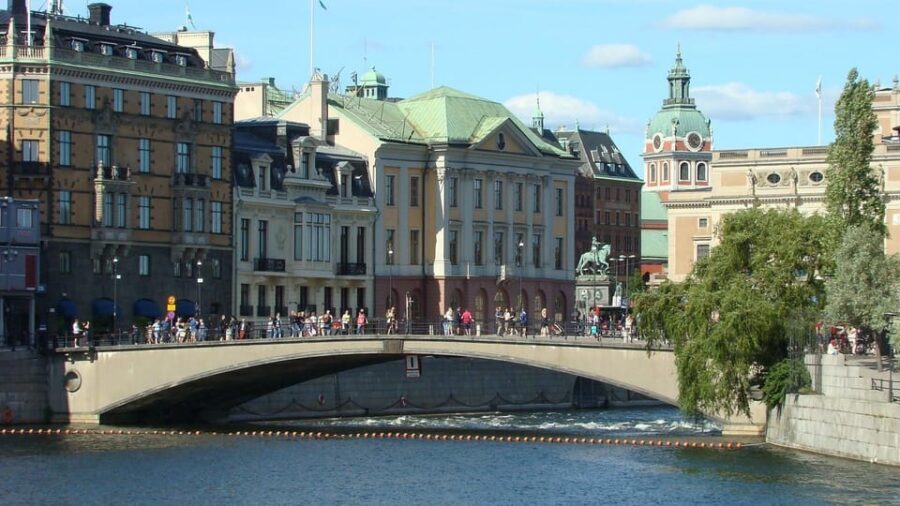
Most Old Town walks start in the classic tourist maze. This one starts in a way that feels practical. You meet at the Gustav III Statue at Skeppsbrokajen (the pier below Slottsbacken), right by the water in central Stockholm. The advantage is simple: you find it without stress, and you’re already oriented to the waterfront before you head into Gamla Stan’s older streets.
The group size is capped at 99 travelers, which matters more than you’d think. It usually means you get a real guide presence and can still hear key points without the whole thing turning into a loud cattle-herd situation. And since the tour is about 2 hours, it’s long enough to connect the dots across centuries, but short enough that it doesn’t eat your whole afternoon.
You’ll also want to know what you’re not getting. This is a walking tour with commentary, not an attraction pass. Entry to museums or paid sites isn’t included, so keep that in mind when you see buildings you might want to go inside later.
You can also read our reviews of more walking tours in Stockholm



Tour pace and your best strategy for cobblestones

You’re outdoors for the full experience, so plan for uneven ground. Gamla Stan’s streets are famous for their cobblestones, which can be great for photos and atmosphere, but not always fun on sore feet. If you’re balancing a tight itinerary, I’d treat this as your anchor activity for the day and then build the rest around it.
Your best strategy is to move with the group at first, then use the Vox City app afterward to slow down on the spots that hook you. The tour itself is designed to give context at each stop, and that helps you avoid the common mistake of staring at a building without knowing why it mattered.
Also, the tour is guided with live English commentary. If you want a different language track, you can use the multilingual audio option through the app (English, Italian, French, Spanish, German). That’s a nice safety net if your travel partner prefers another language, or if you just want to replay a section later.
Opera House to Gustav II Adolf square: the power behind the stories

This walk gives you an early lesson in how Swedish power played out in public spaces. One of the first big historical anchors is the national stage for Swedish opera and ballet, a venue founded in the 18th century by King Gustav III. You’re not just seeing a theater facade here. You’re learning why it became part of a turning point in Swedish history—because Gustav III was assassinated there in 1792, and the interior is known for its lavish look.
From there, you shift to a square named after King Gustav II Adolf, often called the Lion of the North. This is a clever stop because it connects monarchy to the wider Sweden story of military strength. The walk also ties Gustav II Adolf to the ill-fated Vasa ship, which is the kind of fact that makes you pay attention to the street you’re standing on, not just the landmark.
What I like about this portion is that it sets the tone. You start to realize that Gamla Stan isn’t only quaint. It’s political. It’s dramatic. And it’s full of events that still shape how Stockholm is remembered.
Parliament and the underground passage: government that hides in plain sight
Next, the route brings you to the Swedish Parliament building, constructed in the late 19th to early 20th century. The stop isn’t treated as a generic landmark. You get a specific detail that makes it memorable: there’s an underground passage connecting to the Assembly Hall.
That kind of detail changes how you look at the building. Instead of seeing a stately structure, you start thinking about logistics—how people moved inside and how the building functions. Under the bridge, you’ll also hear about the Medieval Museum located beneath, which gives you a nice breadcrumb for anyone who wants to follow the timeline further on their own.
This is a good moment in the tour to slow your pace slightly. Listen carefully, then take a few minutes to look around. The point isn’t just to snap one photo. It’s to connect the architecture to the story the guide is telling.
Old royal residence to the courts: who ruled, who judged
Gamla Stan is packed with buildings that once housed power—and then switched roles over time. The tour points this out in a way that helps you understand the layers of the city.
You’ll see the kind of royal residence that dates back to the 13th century and was later reconstructed after a fire in the 17th century. It served as a royal home until the king moved to Drottningholm Castle. That detail matters because it reminds you Stockholm’s royal center didn’t stay fixed. It shifted with the needs and ambitions of the crown.
Then the walk turns from ruling to judging. You’ll spot a former private residence now used as Sweden’s Supreme Court, the highest court of appeal in the country. You’re basically standing in a place that has moved from private life to national authority, and it makes you notice how buildings in Old Town keep getting reassigned.
A nearby 17th-century building used for events also shows up on this route, with a dark connection to the Gustav III assassination era. Even without going inside, those facts give the stonework a different weight. You stop thinking of it as decoration and start thinking of it as a witness.
If you’re the type who loves turning buildings into stories, this section is where the tour starts feeling worth it.
You can also read our reviews of more guided tours in Stockholm






Riddarholm Church and Birger Jarl square: where monarchs are remembered
The walk includes Riddarholm Church, one of Stockholm’s oldest buildings, and importantly, it’s also the burial site for Swedish monarchs. This is one of those stops that makes the city feel less like a stage set and more like an actual place where history was lived and ended.
From there, you head to a square named after Birger Jarl, who first mentioned Stockholm in 1252. This gives you a real “timeline feeling,” because it jumps you back toward the earliest naming of the city. You’ll also see the Svea Hovrätt, the Swedish High Court, located in this area.
If you’re walking with kids or you’re traveling as a couple, this is a great stretch for conversation. You can ask each other what surprised you most so far: the theaters, the assassination story, or the courts. It’s also a section where photos come out well because the squares give you room to frame the scene.
Nobel Banquet Blue Hall and the Swedish Academy: prestige with a purpose
Then the tour shifts from monarchy and law to modern Swedish international identity—especially the Nobel connection.
You’ll visit the Nobel Banquet area and hear about the stunning Blue Hall. The tour also points out Stockholm City Hall’s iconography—three golden crowns—linked to the Castle of Three Crowns idea. Even if you don’t step inside, seeing how Stockholm visually explains itself is useful. It helps you understand why people treat this city hall area as more than just a building.
The route continues to the Swedish Academy, which oversees the Nobel Prize in Literature, and to the Nobel Museum area honoring Nobel laureates and Alfred Nobel’s legacy. This is valuable because it connects two different kinds of Nobel fame: the literary side and the broader Nobel legacy.
If you care about culture and not just castles, you’ll likely find this part of the walk especially satisfying. And if you’re visiting in the season when Nobel events are in the air, this section will help everything feel less random.
The Great Fire of 1625 area: why the city rebuilt itself
Stockholm has a stubborn memory of disasters. The tour marks an area tied to the Great Fire of 1625, and then balances it with what’s there now—lively spots and modern hangouts like jazz bars (including Stampen) plus boutique shops nearby.
This is a smart way to handle history. Too many tours treat old events like they happened in a museum case. Here, you get a sense that the city burned, recovered, and kept moving. That’s why this stop works even if you’re not a “fire history” person.
Witch trials, ghosts, and the Gray Man: when the tour gets spooky
One of the most atmospheric parts of the walk focuses on one of Stockholm’s oldest streets, with a darker backstory tied to witch trials and ghost legends—especially the tale of the Gray Man.
You don’t need to be a believer to enjoy this section. What matters is how the guide turns rumor and fear into a way to read the city. Narrow street, old stone, and a story about paranoia in earlier centuries. It’s the sort of stop that makes the rest of Old Town feel more alive, because you start noticing corners the way people once must have: wary, curious, and easily spooked.
If your group loves eerie stories, this is the moment. If you don’t, it’s still a good pause in the tour’s otherwise heavy political timeline.
Stockholm Bloodbath square and the cannonball detail
Then you hit one of the most infamous locations in the Old Town story: the oldest square in Stockholm, tied to the Stockholm Bloodbath of 1520. The guide also highlights a physical clue people point to—a cannonball embedded in a building, which is said to symbolize the siege of 1521.
This kind of detail is exactly why a guided walk helps. Without context, you might see a random mark or historical object and skip it. With context, it becomes a symbol you can carry mentally as you walk the rest of Gamla Stan.
This stop can also help you pace emotionally. If you’ve been absorbing lots of political assassinations and legal power, this moment adds violence in a way that the guide frames as part of the larger struggle for control. It’s heavy, but it’s also memorable.
Evert Taube photos, obelisk for Gustav III, and Karl XIV Johan statue
The tour doesn’t stay stuck in medieval drama. It also includes more modern cultural and symbolic stops that help your brain reset between big story beats.
You’ll see a statue of Evert Taube, a famous Swedish author and musician, and it’s described as a great spot for photos. That’s not a throwaway detail. Adding a cultural figure gives you a break from the heavy political narrative and lets you connect Gamla Stan to Swedish arts and everyday identity.
Finally, you’ll reach an obelisk dedicated by King Gustav III, plus a statue of Karl XIV Johan, the French general who became Swedish king. This ending sequence works well because it brings you back to the names you’ve heard throughout the route, and it makes the city feel tied together—across centuries, across different roles of power.
The Vox City app bonus: what you really get after the walk
Here’s where this tour adds value beyond the 2-hour group experience.
Once you purchase your ticket, you get access to the Vox City app, which includes 5 FREE self-guided tours and 125 points of interest across Stockholm. That’s not just a sightseeing list. It’s a way to keep exploring without needing another paid guide for the rest of your day.
The app experience also points you toward other key areas and islands around Stockholm, including Kungsholmen and Djurgården, and it encourages you to stroll past the Royal Palace and the King’s Garden. Even if the walking tour you took didn’t cover all of that directly, the app gives you a path to keep going.
Practical tip: you’re told to download the audio guide by scanning the QR code on your voucher before arrival. Do that ahead of time if you can. You’ll save yourself from app delays while you’re standing by the pier.
Also, note what’s not included: a headset and a mobile device. If you want audio, bring your own phone and plan to use your usual earbuds.
Price and value: is $34.70 a smart buy?
At $34.70 per person for roughly 2 hours, this tour sits in the mid-range for guided Old Town experiences. The value isn’t only in the walking and guide talk. It’s the combination of:
- Live commentary in English
- Multilingual audio support
- The Vox City app with multiple self-guided tours and a lot of listed points
If you’re the kind of traveler who tends to wander without a plan, the app component is a big deal. You’re not just paying for a guided loop; you’re buying a tool for later. And because entry to attractions isn’t included, you’re not locked into overpriced ticket bundles you may or may not want.
If you’re traveling with someone who prefers structure and context, this tour helps you build a mental map quickly. And if you’re solo, it’s a low-risk way to get the “why” behind the sights without turning it into an exhausting museum day.
Who this tour suits best (and who should pick something else)
This guided walking tour is ideal for first-time Stockholm visitors who want to understand Gamla Stan without guesswork. It also suits travelers who like stories that connect rulers, laws, disasters, and culture—because the stops aren’t random. They form a timeline you can remember.
It may be less ideal for travelers who want long museum time or indoor access. Since entry to attractions isn’t included, people chasing ticketed experiences might feel a bit limited.
If your goal is to get your bearings in central Stockholm and set up the rest of your trip, this is a solid move.
Should you book the Stockholm Old Town and City Guided Walking Tour?
Yes, if you want a guided introduction to Gamla Stan that combines big-name landmarks with specific, story-driven details. The live English guide, the option for multilingual audio, and the Vox City app make it more than a basic walk-and-take-photos outing.
You might skip it only if you already know Old Town well and you’re mainly looking for paid attraction entry. In that case, you could build your own plan using the app alone and spend your money elsewhere.
Either way, this is a practical, Stockholm-specific way to spend a couple hours—especially if you plan to continue exploring after the tour ends.
FAQ
How long is the Stockholm Old Town and City guided walking tour?
It’s listed as approximately 2 hours.
Where does the tour start, and where do you end?
The tour starts at the Gustav III Statues at Skeppsbrokajen, 111 30 Stockholm. It ends back at the meeting point.
What languages are available during the tour?
You’ll get live commentary in English, and you also have multilingual audio commentary options in English, Italian, French, Spanish, and German.
Do I need to bring a mobile phone or headphones?
A mobile device and headset are not included. You’ll also scan a QR code on your voucher to download the audio guide, so having your phone with you helps.
Is entry to attractions included?
No. Entry to attractions is not included.
What is included with the Vox City app access?
After purchase, you get access to the Vox City app, including 5 FREE self-guided tours and 125 points of interest across Stockholm.
How big is the group?
The tour has a maximum of 99 travelers.
Can I cancel for a full refund?
Yes. You can cancel up to 24 hours in advance for a full refund. If you cancel less than 24 hours before the start time, the amount paid won’t be refunded.