REVIEW · STOCKHOLM
Stockholm Old Town and the Vasa Museum, a Small Group Walking Tour.
Book on Viator →Operated by Stockholm DriveAndGuide · Bookable on Viator
Old Town stories, then the Vasa ship. This small-group tour gives you a smart, time-saving run through Stockholm’s big sights, with history stitched into the streets. I especially like the included Vasa Museum ticket (so you avoid the worst line moments) and the ferry ride to Djurgården, which changes your view of the city mid-walk. One heads-up: you’ll spend most of the 3 hours moving on cobblestones, and the guided part at Vasa is short, so plan to stay longer if you’re a museum person.
What makes it work in real life is the human scale and the guide’s style. You’re in a group of up to 10, and guides like Natalie or Bengt are known for being organized, helpful with photos, and happy to answer questions. If you hate walking or you want deep museum time, this may feel a bit brisk—but it’s built as an excellent overview and orientation.
In This Review
- Key Things That Make This Tour Worth It
- Starting Underground: Gamla Stan Metro and a Fast Sense of Place
- Riddarholmen and Mälaren Views: The Knights Island Moment
- House of Nobility and Gustav Vasa: Power, Religion, and the Turning Point
- Royal Palace Courtyard and Slottsbacken: Guards, Views, and the Inner Harbour
- Stortorget and Nobel Prize Museum: Sweden’s Big Ideas on a Real Square
- A Short Walk, Then a Ferry: Skeppsbron to Djurgården
- Vasa Museum With a Guide: Getting Oriented Before You Wander
- What Small-Group Really Means on the Street
- Price and Value: Why $125.77 Works for the Right Person
- Practical Tips Before You Go: Cobblestones, Pace, and Shoes
- Who Should Book This Tour (and Who Might Skip It)
- Should You Book This Stockholm Old Town and Vasa Tour?
- FAQ
- What time does the tour start and how long is it?
- Is the Vasa Museum ticket included?
- Is this a walking tour? How much walking should I expect?
- Do I ride a boat during the tour?
- Where do I meet the guide?
- What group size is this tour limited to?
Key Things That Make This Tour Worth It

- Included Vasa entry saves time and stress when the museum line is long
- Ferry to Djurgården breaks up the walk and gives you a new Stockholm perspective
- Small group (max 10) means you can actually ask questions and get personal help
- Big-picture history stop by stop ties names and eras to the exact streets you’re standing on
- Photo-friendly guide approach helps you get good pictures without slowing everyone down
Starting Underground: Gamla Stan Metro and a Fast Sense of Place
Stockholm rewards you when you know where you are. This tour starts in Gamla Stan, at the Gamla Stan Metro station, under/inside the underground area in front of the Pressbyrån kiosk. That matters more than you’d think. In a city with narrow lanes and layers of streets, getting oriented early keeps the rest of your day smoother.
Once you meet your guide, you start with the earliest framing of the story: Stockholm’s setting and the long arc of settlement on the islands. You’re not just hearing random facts. The tour builds a timeline that makes later stops click—especially once you reach the medieval heart of Gamla Stan.
It also helps that the meeting point is near public transport. Even if you’re arriving from somewhere else in the city, you’re not forced into a stressful “find the tour” scramble.
You can also read our reviews of more walking tours in Stockholm



Riddarholmen and Mälaren Views: The Knights Island Moment

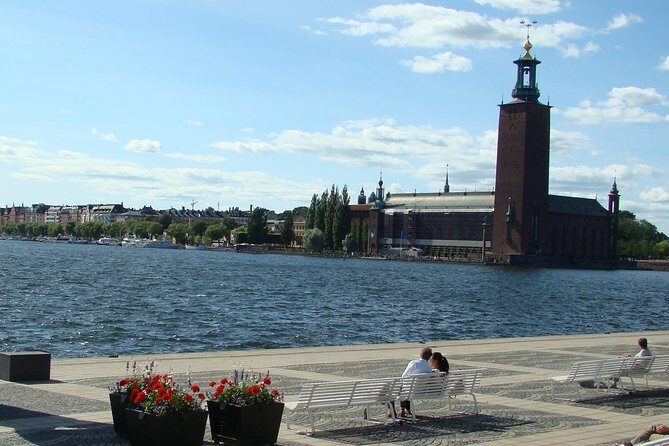
Your first real “wow, I get it now” stop is Riddarholmen, the Knights Island area. You get a view over lake Mälaren toward City Hall, and it’s a useful first anchor: from here, you can understand how the water shaped Stockholm’s growth.
Then it gets specific. Outside Riddarholmen Church, the tour introduces the figure most associated with the early written mention of Stockholm—Birger Jarl. The tour also points out a key year: 1252, when the name Stockholm first appears in a preserved written text. If you tend to remember dates better when they’re tied to a location, you’ll like this format.
A practical plus: these early stops are quick, so you’re not stuck yet. It sets the pace for the whole tour.
House of Nobility and Gustav Vasa: Power, Religion, and the Turning Point
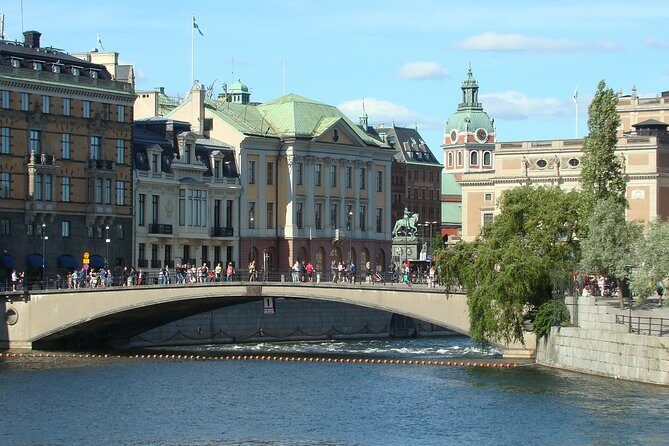
From Riddarholmen, you continue toward Riddarhuset, the House of Nobility. Even if you don’t go inside, you’re meant to look outward—at the building context and at the statue of Gustav Vasa, often described as the father of Sweden.
This is where the tour leans into why Swedish history matters. You hear about 1523, when Gustav Vasa marched into Stockholm and helped shape Sweden’s path as a sovereign state. Then you also get the more dramatic chapter: the uprising linked to the bloodbath of Stockholm, plus the role of nobles at that moment.
The tour also connects politics to religion. You learn that Sweden shifted from Catholicism to Lutheran Protestantism under this broader upheaval. That kind of cause-and-effect is exactly what helps you make sense of what you see later in the Old Town—churches, royal power, and why certain institutions took the form they did.
If you like history that doesn’t feel like a textbook, this segment is one of the best uses of a walking tour. You see the symbols, then you get the story behind them.
Royal Palace Courtyard and Slottsbacken: Guards, Views, and the Inner Harbour
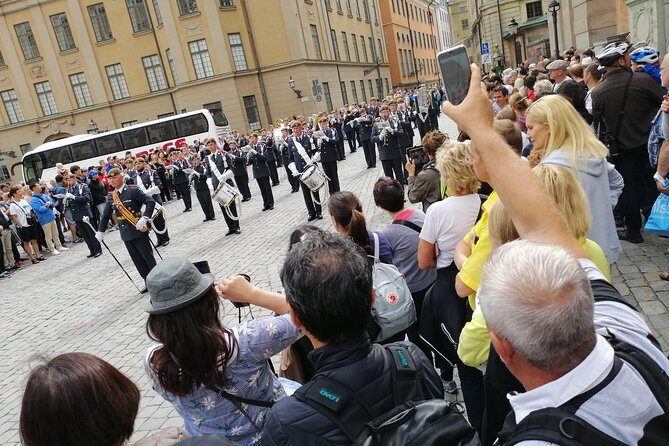
Next up is the Royal Palace area. You go into the outer courtyard, and you can catch the guards—often in elegant uniforms from earlier times. It’s a classic visual stop, but the value is in what it gives your day. Once you’ve seen royal authority in a real setting, the rest of Gamla Stan feels less like a photo hunt and more like a lived-in past.
You also visit Slottsbacken, a spot with a beautiful view toward Stockholm’s inner harbour. This is the kind of pause that helps your brain. You’ve been walking through names and dates; now you see the water and the city’s layout in one glance.
One small practical tip: if you’re trying to get photos, this is a good moment to slow down. Views look best when you’re not rushing through them.
Stortorget and Nobel Prize Museum: Sweden’s Big Ideas on a Real Square
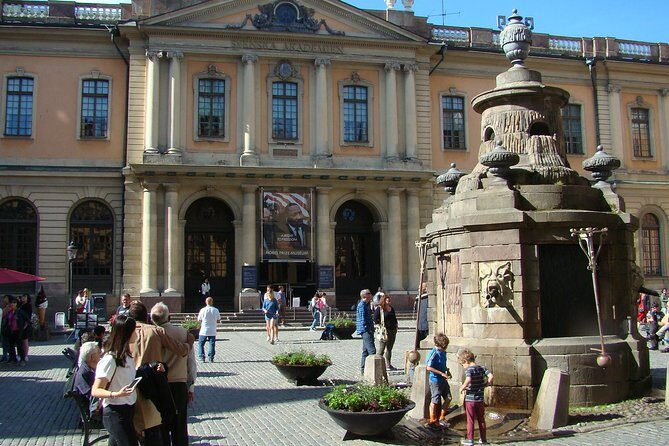
As you move through the Old Town, the tour stops at Stortorget. This is where the Nobel Prize Museum is located. The tour doesn’t just say Nobel and move on. You get context for how winners are designated across major fields in science and the arts—another reminder that Swedish identity isn’t only royal history.
Then the tour keeps stepping through what the Old Town represents. Carl XIV Johan is part of the story now. You hear that he was brought to Sweden from France in the early 19th century, partly tied to diplomacy after conflict with Russia. Instead of focusing only on conquest, the tour emphasizes infrastructure and education. It’s a different style of leadership than the medieval stops you heard earlier.
If you’re hoping to understand why Sweden developed the way it did—especially its later welfare-state foundation—this is the bridge. The tour ties in the industrial revolution, natural resources, and Swedish inventions as part of the broader shift toward modern social structures. It also mentions that 2014 marked 200 years of peace celebrated in Sweden.
That mix—royalty, religion, then later progress—helps Gamla Stan feel like one connected story, not separate set pieces.
You can also read our reviews of more museum experiences in Stockholm






A Short Walk, Then a Ferry: Skeppsbron to Djurgården
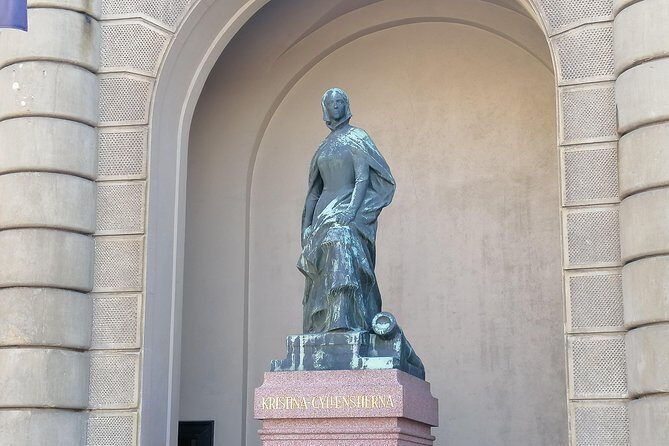
After the Old Town segment, you reach Skeppsbron 26. This is where you take the ferry, the Djurgårdsfärjan, to Djurgården. It’s more than a transportation break. The water view changes your mental map of the city, and it gives you a chance to rest before the last leg.
Here’s how the pacing works in plain terms: you’ll walk about 1 mile in the Old Town, then after the boat trip, about half a mile toward the Vasa Museum. The entire walking portion is roughly 1.5 miles total, and it’s done at a slow pace with photo stops and time to keep up.
If you’re a slower walker, you’ll probably appreciate that the tour is open to adjustment. If you’re a fast walker who hates lingering, just know the tour is designed to pause often.
Vasa Museum With a Guide: Getting Oriented Before You Wander

The guided part ends at the Vasa Museum, and the entrance ticket is included. Your guide shows you the ship and explains the story of the Vasa’s dramatic end—and its later recovery.
The core narrative is simple and gripping: the ship capsized on its maiden voyage and was salvaged more than 300 years later. From the way guides orient you, it’s clear they want you to understand what you’re looking at before you start reading everything at your own pace. You get the key context early, then you’re free to stay.
This matters because the Vasa Museum can be overwhelming if you walk in cold. With a short guided introduction, you know what to focus on—how to interpret the ship’s story and how the museum frames the recovery. After the guided portion, you can explore as long as you want. Many people typically spend around 1.5 to 2 hours inside, and there’s also a café/restaurant if you need a breather.
If you only have a small window of time in Stockholm, this tour is a smart way to see the Vasa without sacrificing the rest of your day.
What Small-Group Really Means on the Street
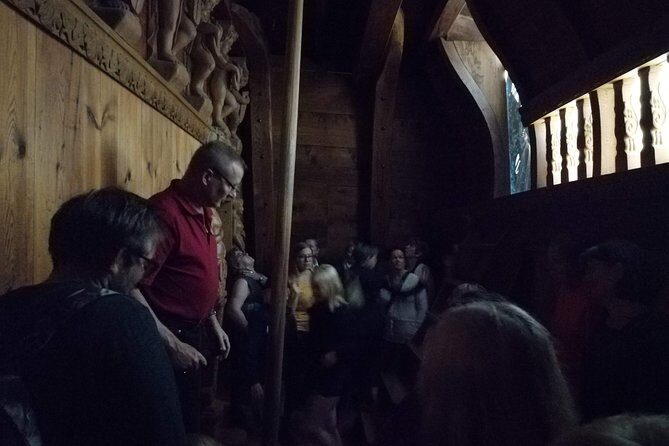
A maximum of 10 travelers sounds nice on paper. On the street, it makes a difference.
First, it’s easier for the guide to manage photo stops without losing the group. Multiple guides, including Natalie and Bengt, are specifically praised for taking care with pictures—so you’re not stuck asking strangers to shoot your memory.
Second, the pace is more flexible. The tour is slow, with frequent pauses at sites. That’s good for cobblestones, and it’s good for people who want to ask why something happened instead of just listening.
Third, you get practical advice woven in. Guides often share recommendations for where to eat and what to do after the tour. That’s not fluff—it’s how you turn a first visit into a good plan for the rest of your stay.
Price and Value: Why $125.77 Works for the Right Person
At $125.77 per person for about 3 hours, the price only feels fair if you’re using the included parts well.
Here’s what’s built in:
- Entry to the Vasa Museum
- The ferry ride from the city to Djurgården
- A guided route through Old Town key sights with history tied to what you’re seeing
- A small-group format that helps you get questions answered
If you were doing this as separate tickets and self-guided wandering, you’d likely spend time standing in lines at Vasa and time trying to connect the dots between places on your own. The included ticket and orientation help you get more out of a limited day.
Is it “cheap”? No. But it’s priced as an efficient intro: you get the major sights of Old Town plus the Vasa, with transport and museum entry folded in.
One more value note: this tour is often booked about 68 days in advance. That’s a hint that it’s popular, especially for people arriving with tight schedules. If your dates are firm, booking early is the smart move.
Practical Tips Before You Go: Cobblestones, Pace, and Shoes
This is a walking tour with moderate physical fitness needed. You’ll cover around 1.5 miles total, and a lot of it includes cobblestone streets. That sounds minor until you’re doing it with city walking shoes that you wore the day before.
I’d plan on:
- Good shoes with solid grip
- A light layer. Stockholm weather changes faster than your plans
- Comfortable pacing. The tour is slow, but you’re still walking
Also, bring your attention to the guide’s timing. Some stops are very short. If you’re the type who wants to read every plaque immediately, you may want to take notes lightly during the guided portion and save the deeper reading for the Vasa museum when you’re on your own.
Who Should Book This Tour (and Who Might Skip It)
This tour is ideal if:
- You want a fast, organized overview of Stockholm’s Old Town history
- You care about the Vasa Museum and want a guided orientation first
- You’d rather ask questions than manage a confusing route solo
- You like small groups and photo-friendly pacing
You might choose a different option if:
- You struggle with cobblestones or longer standing/walking days
- You want a deep, slow museum day inside Vasa only, without walking between sites
- You’re hoping for minimal walking and maximum free time
Should You Book This Stockholm Old Town and Vasa Tour?
If it fits your day, I’d book it. This is one of those tours where the included museum ticket plus the ferry break help you cover real ground without turning your trip into a logistics puzzle. You get a guided path through Gamla Stan that makes the history feel connected, and then you land at the Vasa Museum with the story already in place.
Just be honest about one thing: you’re going to walk. If you’re good with cobblestones and a paced 3-hour outing, this is a strong first-day choice in Stockholm—then you can build from there.
FAQ
What time does the tour start and how long is it?
The tour starts at 10:00 am and lasts about 3 hours.
Is the Vasa Museum ticket included?
Yes. Entrance to the Vasa Museum is included, and your guide shows you the ship and tells the story.
Is this a walking tour? How much walking should I expect?
Yes. It’s a walking tour with about 1.5 miles total (about 2.4 km). You walk about 1 mile in Old Town and another 0.5 miles after the boat ride.
Do I ride a boat during the tour?
Yes. From Skeppsbron you take the ferry Djurgårdsfärjan to Djurgården.
Where do I meet the guide?
You meet near Munkbrogatan 8, at Gamla Stan Metro station underground in front of the Pressbyrån convenience store.
What group size is this tour limited to?
The tour has a maximum of 10 travelers, and it’s offered in English.