REVIEW · STOCKHOLM
The Story of Stockholm and Sweden in Three Chapters, a Small Group Walking Tour
Book on Viator →Operated by Stockholm DriveAndGuide · Bookable on Viator
Sweden has a way of surprising you. This small-group walking tour tells the country’s story as you walk, with stops that connect early settlement, royal power, and modern life in a way you can actually remember.
I especially like the three-chapter structure. It turns a dense subject into something you can follow on foot, from the first mentions of Stockholm to the politics that shaped today’s Sweden. The walk also keeps you moving through real locations, not just theory.
One more thing I like: admission is included along the way, so you spend time looking at the sights instead of queueing for tickets. The main drawback is pace: it is a 2-hour format with short stops, so if you prefer to linger and read every plaque slowly, you might feel a bit rushed.
In This Review
- Key things to know before you go
- A Three-Chapter Walk Through Stockholm’s Real Turning Points
- Small Group Comfort, Included Admission, and a Practical Route
- Stop-by-Stop: What You Learn at Each Moment
- Start at Gamla Stan Metro (under the streets)
- Stop 1: Riddarholmen historical marker (and palace views)
- Stop 2: Riddarholmen Church area and Birger Jarl
- Stop 3: Riddarhuset (House of Nobility) and Gustav Vasa
- Stop 4: Vasabron and the heirs after Gustav Vasa
- Stop 5: Riksdagshuset (Swedish Parliament Building)
- Stop 6: Royal Palace area (Lejonbacken) and the eastward wars
- Stop 7: Old Town toward Carl XIV Johan
- Stop 8: Stortorget, Nobel Price Museum area, and guard changing timing
- How Sweden’s Big Ideas Fit Together: Politics to Modern Inventions
- Price and Value: Why This Walk Can Be Worth $61.28
- Pace, Comfort, and How to Get the Most From 2 Hours
- Who This Tour Suits Best
- Should You Book This Stockholm Three-Chapter Walk?
- FAQ
- How long is The Story of Stockholm and Sweden in Three Chapters?
- What language is the tour offered in?
- What is the group size limit?
- Where does the tour start and end?
- Is admission included?
- Is there free cancellation?
Key things to know before you go
- Three chapters, one walking route: Early Stockholm, the Gustav Vasa era, and the modern state all get their own “act.”
- No line-hassle for key parts: Admission is included for the stops where it matters.
- Small group capped at 10: More manageable than large bus tours, and easier to hear your guide.
- You’ll connect monarchy to everyday life: Politics, religion, diplomacy, and later prosperity all tie together.
- A smart Old Town finish: You end near Stortorget, close to the Royal Palace and the changing of the guards.
A Three-Chapter Walk Through Stockholm’s Real Turning Points
The best Stockholm tours do two things at once: they help you find your way and they help you understand what you’re seeing. This one does both, and the three-chapter approach is the trick.
Chapter one starts in the area around Riddarholmen, where the story begins long before today’s skyline. You’ll talk through the ice age, the first settlements on the islands, and the early moments when Stockholm starts showing up in written records. It’s not random sightseeing; it’s a guided timeline you can walk alongside.
Then chapter two shifts toward the political and religious shake-ups that defined Sweden’s independence and direction. You’ll hear about Birger Jarl and the early written mention of Stockholm (1252), then move forward to Gustav Vasa and the upheavals that followed. After that, the tour moves into chapter three, where you connect Swedish sovereignty, wars, Enlightenment ideas, and eventually the welfare-state foundations that grew with industry and inventions.
For your brain, that structure is gold. You don’t just collect facts. You connect them.
You can also read our reviews of more walking tours in Stockholm

Small Group Comfort, Included Admission, and a Practical Route
This is built as a small-group walking tour capped at 10 travelers. That matters more than it sounds. In a city like Stockholm, where streets can be tight and landmarks are spread in a stop-and-go pattern, small groups keep things flowing and make it easier to hear explanations.
The second practical win is included admission along the way. You get a mobile ticket, and rather than spending time hunting down separate tickets for each stop, you’re guided through the sections that have entry value. It’s one less hassle when you’re on your feet.
Also, the itinerary is designed so you start near transit and finish in the historic core. You begin at the Gamla Stan Metro station area (inside/underground, in front of the Pressbyrån kiosk), and the route ends at Stortorget. That means it plugs neatly into the way most people tour Old Town and the Royal Palace area.
The one caution I’d give you: the tour’s duration is about 2 hours, and many moments are brief (think 10 to 20 minutes per stop). It’s not a slow museum day. It’s a fast, story-driven walk.
Stop-by-Stop: What You Learn at Each Moment
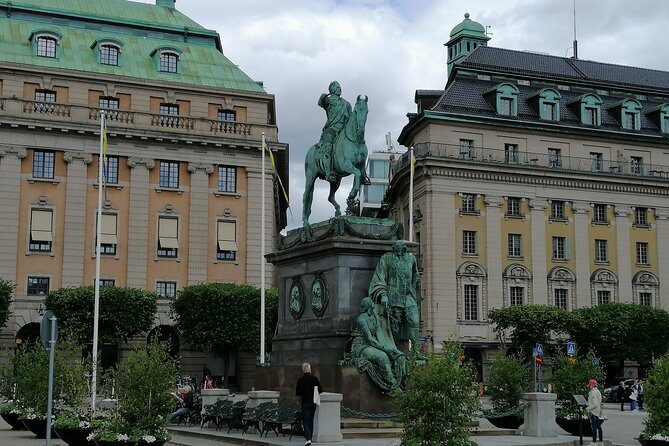
Here’s what to expect as the story moves from stop to stop, and why each one matters.
Start at Gamla Stan Metro (under the streets)
Your meeting point is listed at Munkbrogatan 8, but the walk begins at Gamla Stan Metro station, inside/underground, in front of the Pressbyrån kiosk. That’s a nice setup: you’re already in the historic zone fast, without wasting the first part of your tour hunting for the start.
Stop 1: Riddarholmen historical marker (and palace views)
The first stop points you toward early Stockholm and Sweden, starting from the ice age and moving toward the first settlement patterns on the islands. This is where the tour earns its “chapter” name. The explanation doesn’t float in the abstract—you get ground-level context for why this area mattered.
You’ll also walk around and visit open parts of the palace. The time here is short, but it sets your reference points so later stops feel connected instead of random.
Why it works: you begin with origins. You don’t start with kings and wars. You start with place.
Possible downside: if you’re hoping for a deep palace interior visit, this isn’t that kind of tour. It’s more about orientation and story than long indoor time.





Stop 2: Riddarholmen Church area and Birger Jarl
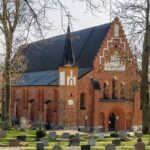
Outside Riddarholmen Church, you meet the presumed founder of Stockholm, Birger Jarl—or rather, a statue that represents him. Then you land on a key milestone: 1252, the year Stockholm is first mentioned in a written text that still survives.
The guide uses this moment to anchor chapter one in something you can point to: not just legend, but record-keeping and early documentation.
Why you’ll care: when a city can show you its earliest written references, it gives you a timeline you can trust.
Stop 3: Riddarhuset (House of Nobility) and Gustav Vasa
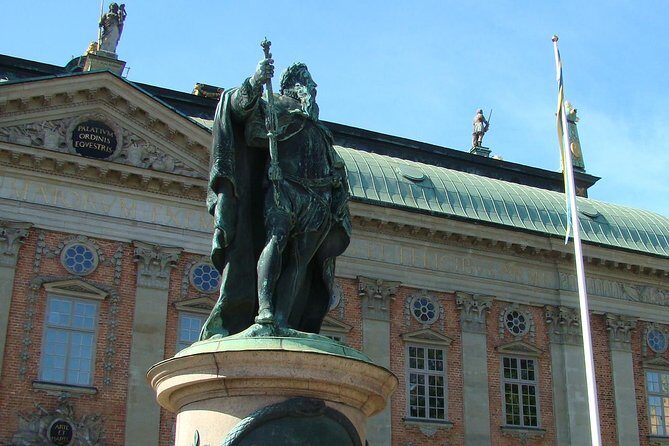
At Riddarhuset, you look at the statue of Gustav Vasa, often called the father of Sweden. This is the shift into chapter two. You’ll hear how Gustav Vasa’s rise after major loss set off a chain of events that changed Sweden’s future.
The tour highlights the shock of the bloodbath of Stockholm, including the death of Gustav Vasa’s father and other noblemen (between 80 and 100, as given in the narration). Then comes the uprising against the southern neighbor that controlled Sweden at the time.
And it doesn’t stop at politics. The guide also connects this era to religion—Sweden moving from Catholicism to Lutheran Protestantism.
What makes this stop valuable: religion and power are tangled here, and the tour treats them as part of the same story.
Stop 4: Vasabron and the heirs after Gustav Vasa
You cross to the other side near Vasabron, where the narrative continues with Gustav Vasa’s heirs. You’ll hear about Gustav II Adolf, described here as one of Sweden’s greatest warrior kings, and how during his reign the Baltic Sea became almost like an inland sea, surrounded by Swedish possessions.
This stop is a good example of how the tour turns maps into meaning. If you’ve ever looked at Sweden on a globe and wondered why the Baltic mattered so much, this part explains the stakes in human terms.
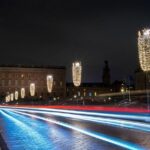
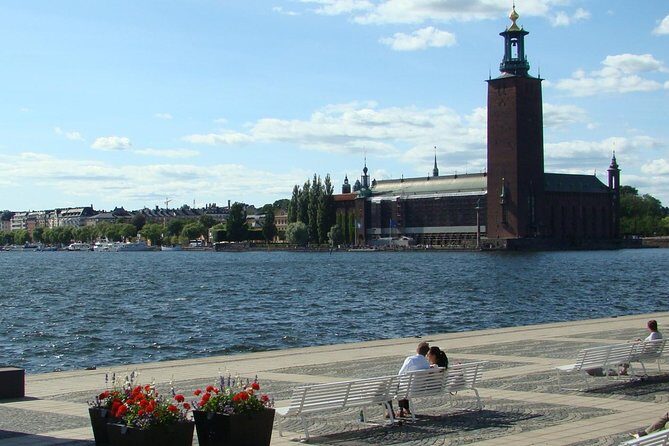
Stop 5: Riksdagshuset (Swedish Parliament Building)
Next is the Parliament Building, or Riksdagshuset. This is where the tour gets surprisingly relevant, even if you’re not a politics nerd.
The key idea: Sweden’s parliament didn’t start as the modern democracy you might imagine. You’ll learn about the earlier Riksdag of the Estates (Ståndsriksdagen), with nobles, clergy, burghers, and peasants meeting separately before coming together with the king. The tour notes that this institution was the top authority alongside the king until its dissolution in 1866.
Then you’ll hear how a two-chamber parliament was introduced in 1866, still with unequal voting rights. After a political struggle led by liberals and socialists, the tour points to general suffrage in 1921.
Why this stop works for you: it doesn’t just name dates. It shows that “democracy” is a process, and Sweden’s version took time.
Stop 6: Royal Palace area (Lejonbacken) and the eastward wars
Now you start chapter three at Lejonbacken, on the north side of the Royal Palace. This section shifts from institutions to power, war, and ideas.
You’ll hear how Peter the Great of Russia ended Swedish ambitions in Northern Europe. Then the focus moves to Karl XII, the last of the warrior kings, still pointing east—where his army, the Caroleans, first had victories, before being defeated by Peter the Great in Poltava 1709.
The story then pulls in the Enlightenment. It mentions Gustav III as an enlightened ruler with a strong interest in theatre and arts and science—showing that Sweden’s evolution wasn’t only about battlefields.
Stop 7: Old Town toward Carl XIV Johan
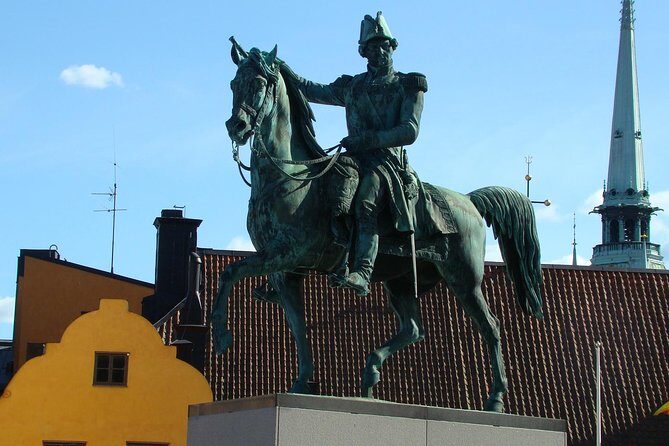
Below the statue of Carl XIV Johan (the first of the Bernadottes), the tour continues with Sweden’s shift toward diplomacy and national development.
You’ll hear that Carl XIV Johan was imported from France at the start of the 19th century to help Sweden win back what was lost to Russia. But the guide frames a change in approach: less about conquest, more about diplomacy, infrastructure, and education.
Then the narration brings you forward to modern identity. You’ll hear about 2014 and the celebration of 200 years of peace in Sweden. After that, the tour connects the industrial revolution, natural resources, and Swedish inventions to foundations for a welfare state—then continues into how entrepreneurs carried development into the 20th and 21st centuries.
This is one of the places where the tour’s modern tie-ins show up. If you’ve heard of Swedish success stories like Spotify and IKEA, you’ll get help understanding how Sweden’s long arc—from political stability to social systems—creates the conditions where companies can grow.
Stop 8: Stortorget, Nobel Price Museum area, and guard changing timing
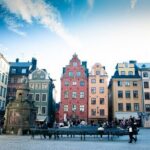
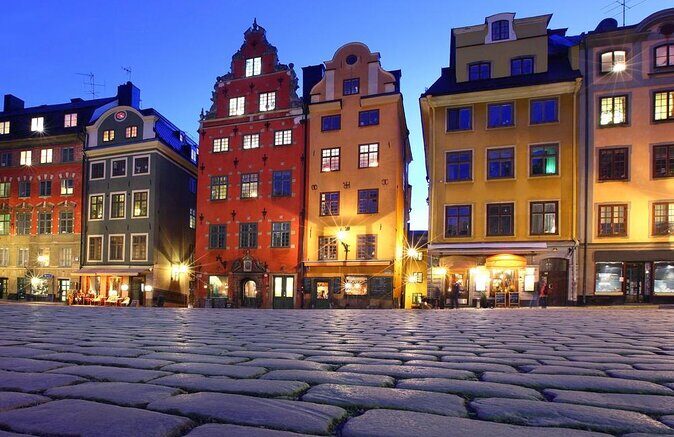
Your tour ends at Stortorget, near the Nobel Price Museum. The Swedish Royal Academies designate winners for prestigious prizes in science and art, and this stop is a neat bridge between the earlier chapters (power and institutions) and Sweden’s reputation for ideas and achievement.
The ending is also practical: you finish close to the Royal Palace at a time that lines up well with the changing of the guards. During summer months, the parade can include marching or riding with the Music Corps through up to the Outer Courtyard of the palace.
So you get two things on the finish line: a meaningful cultural marker and a very photogenic routine.
How Sweden’s Big Ideas Fit Together: Politics to Modern Inventions
What I like about this tour is that it treats history as causal, not just chronological.
It’s easy to visit a palace and think you’ve absorbed culture. This walk makes the palace part of something bigger: the shift from estates meeting separately, to equal voting rights coming later, to the development of a society that can support long-term welfare and innovation.
And it’s not only old kings talking to other old kings. By the time you reach the Carl XIV Johan segment, the tour connects diplomacy and education to the longer runway for prosperity. That helps explain why Swedish inventions and major companies feel like they belong in Sweden, not like sudden miracles.
Even the modern company references are used as proof that the story doesn’t end in the 1700s. The tour uses names like Spotify and IKEA to show that Sweden’s later identity is tied to the earlier choices it made about institutions, stability, and social development.
Price and Value: Why This Walk Can Be Worth $61.28
At $61.28 per person for about 2 hours, this tour sits in the “pay for convenience and clarity” category.
Here’s the value logic:
- Small group size (up to 10) gives you better listening and less crowd stress.
- Included admissions mean you are not paying extra for access to the key parts that your route touches.
- The route is tightly planned so you spend your time learning at the most relevant locations, then you end near a major sightseeing draw.
If you’re the type who likes history but doesn’t want to spend a half-day piecing together separate tickets and waiting times, this price starts to look reasonable. You’re paying for a guided narrative plus a smart route through Stockholm’s most story-friendly spots.
Pace, Comfort, and How to Get the Most From 2 Hours
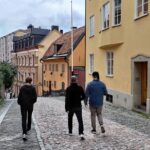
This is a moderate physical fitness kind of experience. You’re walking in central Stockholm, moving between landmarks, and each segment is relatively short. That’s great for energy levels, but it also means there’s little time to wander off and explore slowly.
My practical advice: treat this like a history “orientation lap.” After the tour, you’ll know where to go back to, and you’ll understand what you’re looking at. Without that, Old Town can feel like a set of pretty buildings with confusing names.
Because the stops are time-boxed, come prepared to listen rather than read every sign. If you love facts, you’ll still get plenty—especially with the repeated emphasis on dates like 1252, 1523, 1866, 1921, and 1709.
Who This Tour Suits Best
This works well if:
- You want structure. You like learning with a clear storyline.
- You enjoy seeing how the past explains the present—especially in politics, religion, and institutions.
- You want a small group without the chaos of a larger crowd.
- You’re planning a Stockholm day and want a tour that ends at a strong sightseeing spot near the Royal Palace.
It might not fit as well if:
- You prefer long museum time and slow wandering.
- You dislike tours where you’re frequently moving and the explanations are tightly timed.
Should You Book This Stockholm Three-Chapter Walk?
I’d book it if you want a fast way to understand Sweden without feeling lost. The three-chapter approach is the biggest reason: it gives you a mental map from origins, to sovereignty and religion, to modern institutions and Nobel-era culture.
You’re also paying for included admission and a group size that stays manageable. When a walking tour gives you both story and logistics, it tends to deliver more than the average “see the sights” format.
If your schedule allows only a limited window in Old Town, this is a smart use of time—because you finish where you want to be anyway, near the changing of the guards.
FAQ
How long is The Story of Stockholm and Sweden in Three Chapters?
The tour lasts about 2 hours.
What language is the tour offered in?
It is offered in English.
What is the group size limit?
The tour has a maximum of 10 travelers.
Where does the tour start and end?
It starts at the Gamla Stan Metro station area near Munkbrogatan 8 and ends at Stortorget near 111 29 Stockholm.
Is admission included?
Yes. Admission is included along the way at the listed stops.
Is there free cancellation?
Yes. You can cancel for a full refund up to 24 hours in advance of the experience start time.